
Home / Blog / Dental chart templates
Free Printable Dog and Cat Dental Chart Templates
Looking for a dog dental chart template or a cat dental chart template you can print today? Below are two free veterinary dental charts: every tooth is numbered with the modified Triadan system, the codes follow AVDC abbreviations, and a second page gives you room for notes. Download the PDF, or open the printable page and print it.
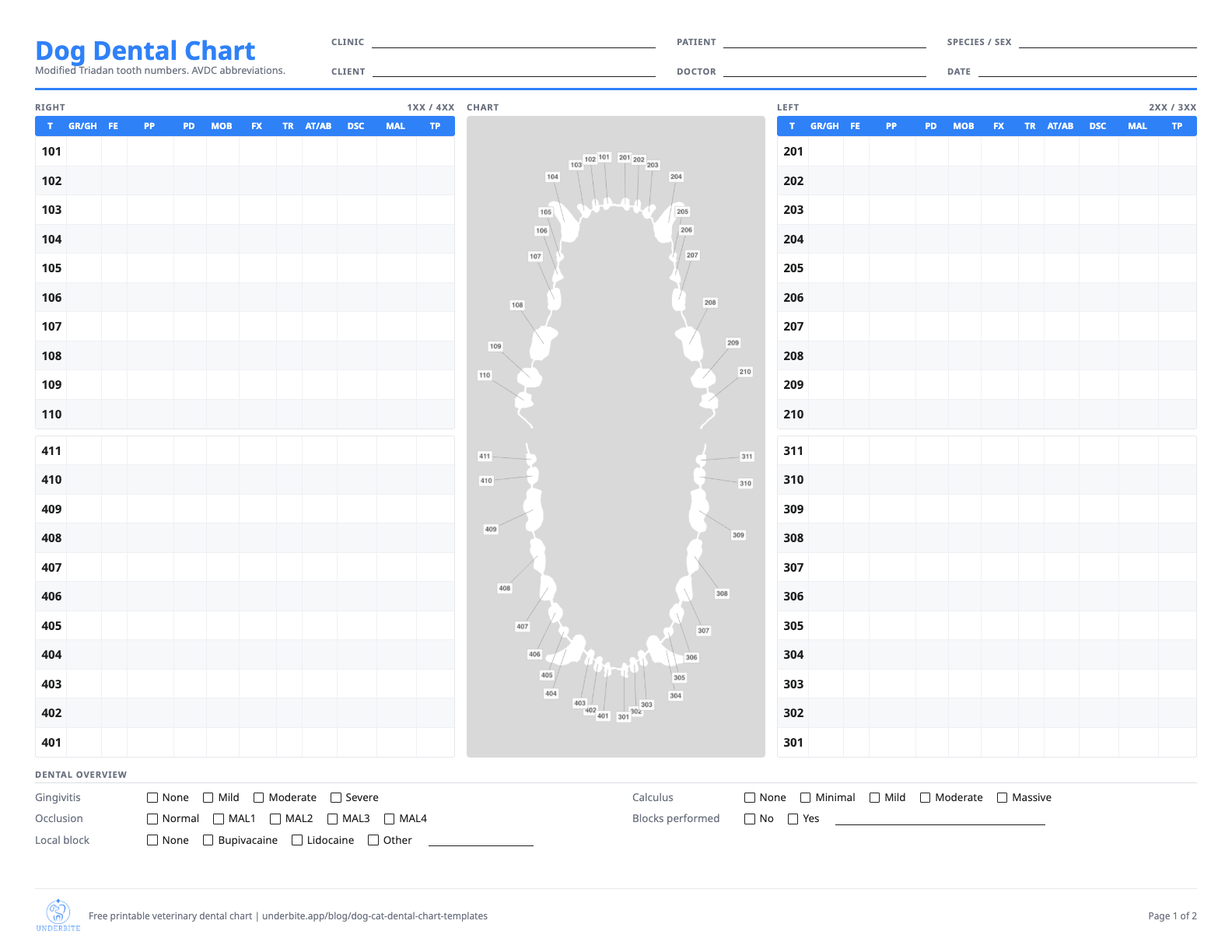
Dog dental chart template
42 teeth, numbered 101 to 110, 201 to 210, 301 to 311 and 401 to 411.
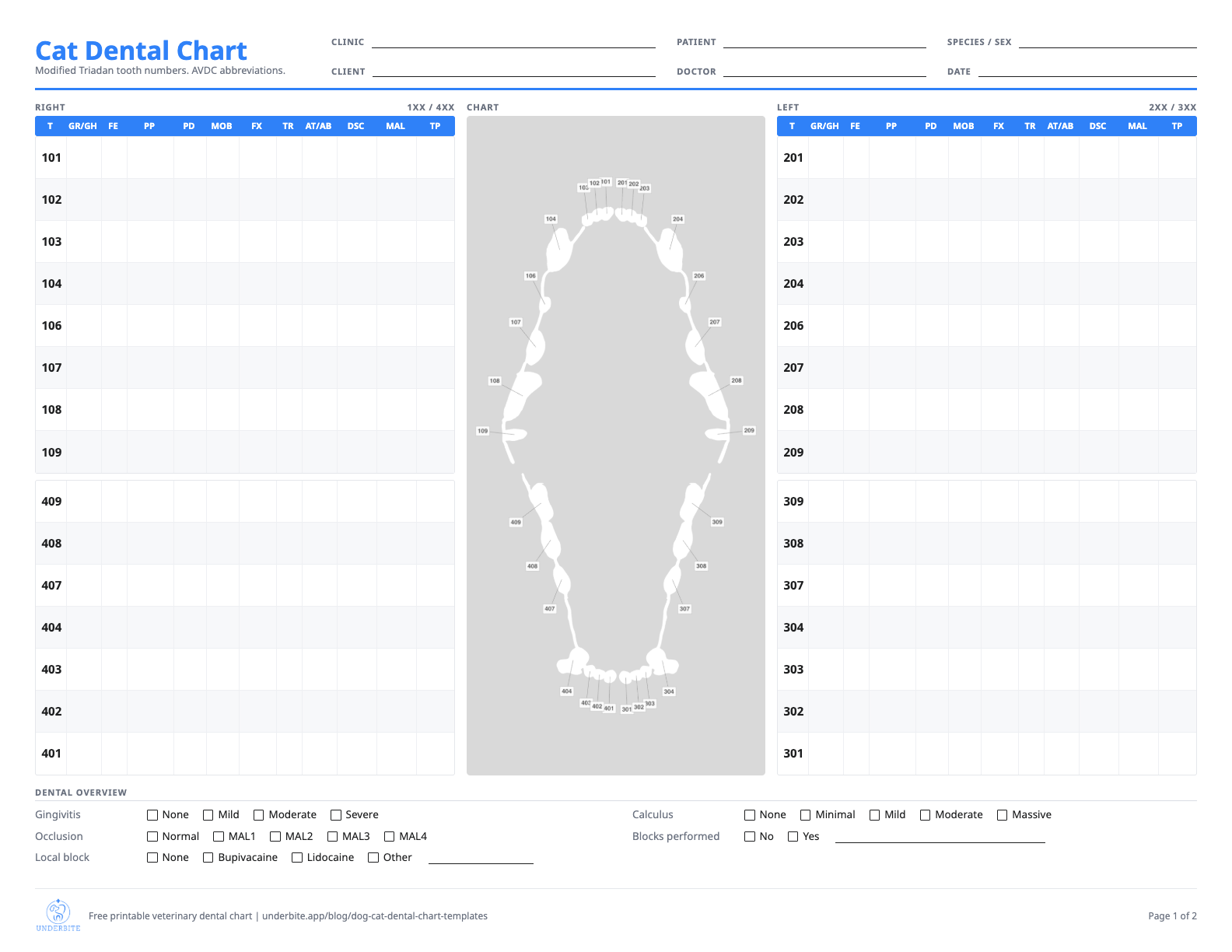
Cat dental chart template
30 teeth in the standard feline numbering, with gaps where cats have fewer premolars.
Tired of charting by hand? Try the Underbite demo.
Try the live demoWhat is on the chart
A veterinary dental chart records what you find in each tooth during an oral exam, in a form the next person can read at a glance. Each template has the same parts:
- Patient details: clinic, patient, species and sex, client, doctor and date.
- One table per side of the mouth. The right side (teeth 1xx and 4xx) is on the left of the page and the left side (2xx and 3xx) is on the right, so the page reads like the patient facing you. The upper teeth are in the top block and the lower teeth in the bottom block.
- The tooth diagram in the middle, with every tooth shown and labelled, so you can find a tooth by its shape.
- Twelve columns per tooth for the findings you record most: gum line, furcation exposure, probing depths, periodontal disease stage, mobility, fracture, tooth resorption, attrition and abrasion, discoloration, malocclusion and treatment plan.
- A dental overview with tick boxes for gingivitis, calculus, occlusion, blocks performed and local block.
- On page 2, a key to the abbreviations and ruled lines for general notes and tooth notes.
These use the same layout, columns and abbreviations as the charts Underbite's charting software prints. If you later chart on screen, your paper charts and your digital charts will follow the same format.
How teeth are numbered: the modified Triadan system
Every tooth has a three digit number. The first digit is the quadrant, and the last two digits count the teeth from the midline backward.
| First digit | Quadrant |
|---|---|
| 1 | Upper right (maxillary right) |
| 2 | Upper left (maxillary left) |
| 3 | Lower left (mandibular left) |
| 4 | Lower right (mandibular right) |
So 104 is the upper right canine, 208 is the upper left fourth premolar, and 409 is the lower right first molar in a dog. The number of a tooth never changes when a neighbor is missing: the numbering leaves a gap instead. That is why the cat chart skips 105, 205, 305, 306, 405 and 406. The American Veterinary Dental College calls the modified Triadan system the numbering system of choice in veterinary dentistry.
| Tooth type | Dog | Cat |
|---|---|---|
| Incisors | 01, 02, 03 | 01, 02, 03 |
| Canine | 04 | 04 |
| Premolars | 05 to 08 (upper and lower) | 06, 07, 08 upper; 07, 08 lower |
| Molars | 09, 10 upper; 09, 10, 11 lower | 09 (upper and lower) |
| Total adult teeth | 42 | 30 |
How to fill in the chart
- Fill in the patient details at the top, and tick the dental overview boxes once you have examined the whole mouth.
- Work one tooth at a time. Find the tooth's row, using the diagram if you need to confirm its position, and write a code in the column for each finding. Leave a column blank when the tooth is normal for that finding.
- Mark missing and extracted teeth on the diagram (shade or cross out the tooth), and note which teeth are missing and which were extracted.
- Plan treatment in the last column and add detail on page 2. Use the tooth notes for anything the columns cannot hold, such as a radiograph finding or a client discussion.
- Sign and date the chart before it goes in the record.
The abbreviations are AVDC abbreviations where AVDC has one (for example PD2, UCF, XSS).
A few columns have no AVDC abbreviation, and the key marks those with an asterisk. The next section covers the codes you will use
most.
Quick reference for the most-used codes
Periodontal disease stage (PD)
| Code | Meaning (AVDC) |
|---|---|
| PD0 | Clinically normal. |
| PD1 | Gingivitis only, without attachment loss. |
| PD2 | Early periodontitis: less than 25% attachment loss, or at most a stage 1 furcation involvement. |
| PD3 | Moderate periodontitis: 25 to 50% attachment loss, or a stage 2 furcation involvement. |
| PD4 | Advanced periodontitis: more than 50% attachment loss, or a stage 3 furcation involvement. |
Tooth mobility (M) and furcation (F)
| Code | Meaning (AVDC) |
|---|---|
| M1 | Mobility increased in any direction other than axial, over more than 0.2 mm and up to 0.5 mm. |
| M2 | Mobility increased in any direction other than axial, over more than 0.5 mm and up to 1.0 mm. |
| M3 | Mobility over 1.0 mm, or any axial movement. |
| F1 | A periodontal probe extends less than halfway under the crown of a multirooted tooth with attachment loss. |
| F2 | A probe extends more than halfway under the crown, but not through and through. |
| F3 | A probe passes through and through from one side of the furcation to the other. |
Tooth fractures (FX)
| Code | Meaning (AVDC) |
|---|---|
| EI | Enamel infraction: an incomplete fracture (crack) of the enamel without loss of tooth substance. |
| EF | Enamel fracture: loss of crown substance confined to the enamel. |
| UCF | Uncomplicated crown fracture: the pulp is not exposed. |
| CCF | Complicated crown fracture: the pulp is exposed. |
| UCRF | Uncomplicated crown-root fracture: crown and root, pulp not exposed. |
| CCRF | Complicated crown-root fracture: crown and root, pulp exposed. |
| RF | Root fracture. |
A note on tooth resorption (TR). The TR column records where the resorption is: 1 for the crown, 2 for the root and 3 for both. AVDC also classifies tooth resorption by stage, TR1 to TR5. If you stage resorption, write the stage in the tooth notes.
Tips for charting well on paper
- Chart as you go. Writing findings while the mouth is open is faster and more accurate than reconstructing them afterward.
- Use pencil or a fine pen and print a fresh page for each patient. The rows are small, so short codes are easier to read than words.
- Keep the key beside you. Page 2 has every abbreviation, so a new technician can chart in the same shorthand as the doctor.
- Note what you did not examine. A blank cell is ambiguous: it can mean normal or not checked. Say so in the notes when it matters.
- Check your record rules. Requirements for what a dental record must contain vary, so make sure the chart covers what your practice and jurisdiction expect.
Frequently asked questions
Are these dog and cat dental chart templates free?
Yes. Download the PDF or open the printable page and print as many copies as you need. No account or sign-up is required.
What size are the dental chart templates?
US letter, landscape. Each template is two pages: page 1 is the chart, and page 2 holds the abbreviations and ruled space for general and tooth notes.
Which tooth numbering system do the templates use?
The modified Triadan system, described above. The first digit is the quadrant and the last two digits count the teeth from the midline.
How many teeth are on a dog and a cat dental chart?
The dog chart has 42 teeth, the number in a complete adult canine mouth. The cat chart has 30, the number in a complete adult feline mouth.
Can I fill in a dental chart on screen instead of by hand?
Yes. Underbite is veterinary dental charting software with an interactive chart for dogs and cats, and you can try it in a live demo without creating an account.
Would you rather not write it by hand?
Underbite fills in the same chart on screen: click a tooth, pick the findings, and export a clean PDF. Chart a dog or cat in the live demo, with no account needed.
These templates are provided for record-keeping convenience and are not medical advice. Abbreviations follow AVDC nomenclature; Underbite is not affiliated with the AVDC.